


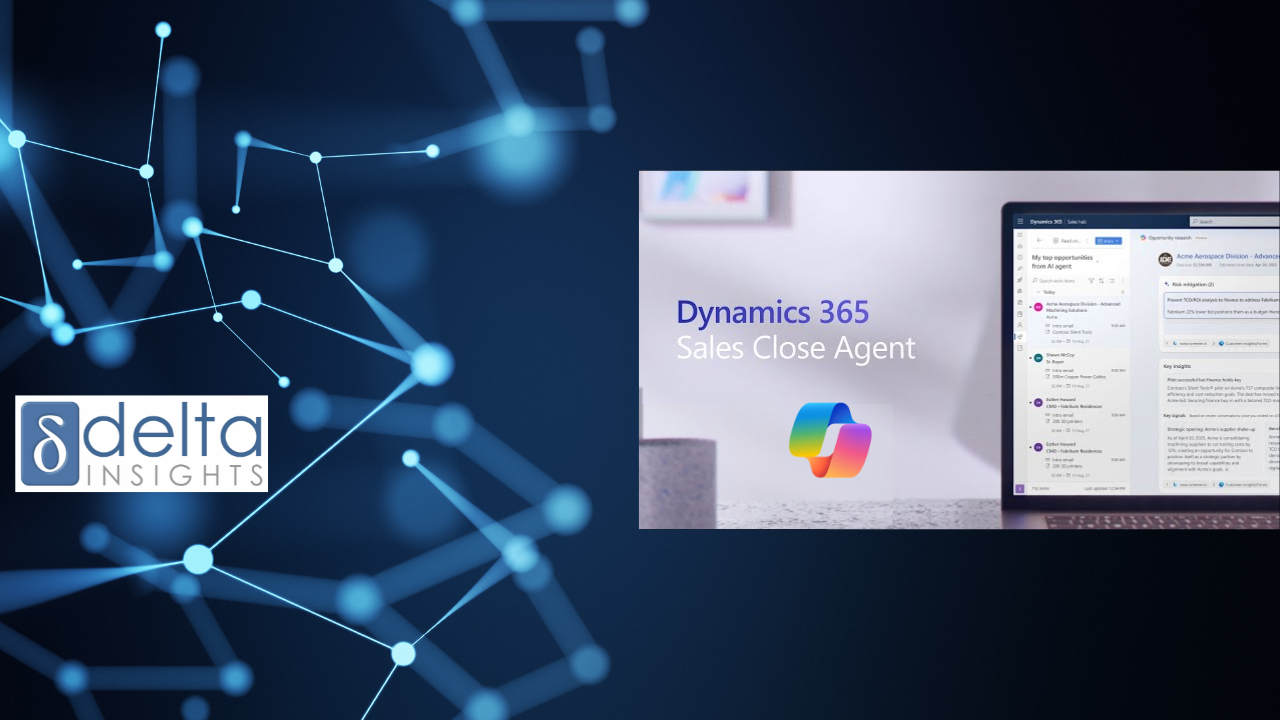
Agent Brief: Sales Close Agent - From Hype to Real AI Value
A practical guide to piloting Dynamics 365 Sales Close Agent to improve deal momentum, pipeline discipline, and forecasting confidence.
Issue #8 | 25 March 2026 | 4 min read
Bringing more momentum to the deals that matter.
The new Sales Close Agent in Dynamics 365 is built for the part of the funnel where deals often drift. Not lead qualification. Not prospecting. Closing.
It works on opportunities already in your pipeline. It can monitor deal health, spot blockers, draft follow-ups, and in some cases take action automatically.
That makes it one of the more practical AI additions to Dynamics 365 Sales so far.
But like most sales AI, the real value depends on what sits underneath it. If your stages are clear, your opportunity data is in good shape, and your team has a consistent sales process, this agent can help create momentum where deals usually slow down.
At a glance
- The Sales Close Agent is designed to support active opportunities in Dynamics 365
- It can monitor, research, recommend, and in some cases engage on deals already in play
- It works best where opportunity stages, follow-up expectations, and close criteria are already clear
- It can help improve deal velocity, pipeline discipline, and seller focus
- It is most effective when paired with strong CRM data and a defined sales process
What it is
Sales Close Agent is the deal-focused counterpart to the Sales Qualification Agent. While the qualification agent works at the top of the funnel, the close agent is aimed at opportunities that are already in flight.
It can operate in two modes:
- Research mode: The agent reviews opportunities, researches account context, identifies risks or gaps, and drafts suggested next steps. Sellers stay in control and decide what to send.
- Engage mode: The agent takes action using the rules you set. That might include sending follow-ups, requesting missing information, or nudging deals that have stalled. It escalates when human judgement is needed.
You decide which opportunities it watches, how often it reassesses them, and what criteria matter most, such as stage, value, age, owner, or product line.
Why it matters
This is not really about AI replacing your sales team.
The more practical value is in helping your team maintain momentum across active opportunities, especially in the later stages where deals often lose pace.
- Better follow-up discipline: Deals stall when nobody owns the next step. This agent can help make sure follow-up happens consistently, especially in proposal and negotiation stages.
- Faster movement through the pipeline: When delays, missing information, or inactive stakeholders are surfaced earlier, reps can act sooner.
- More time for sellers to sell: Reps spend less time checking status, chasing updates, or drafting repetitive follow-up emails.
- Stronger forecasting: If the system is actively tracking momentum, blockers, and activity gaps, your pipeline view becomes more realistic.
Where it adds the most value
Sales Close Agent is a good fit for teams that already have:
- clear opportunity stages
- agreed close criteria
- regular pipeline hygiene
- enough deal volume for follow-up to become inconsistent
- sellers who want support, not more admin
In those environments, it can become a useful layer of consistency across the pipeline.
What needs to be in place first
There are still a few obvious failure points if the foundations are weak.
- Generic outreach: If the agent sends bland, repetitive follow-ups, buyers will notice.
- Bad targeting: If it watches every opportunity, including weak or low-value ones, reps will tune it out.
- Weak CRM data: If opportunity records are incomplete or inconsistent, the recommendations will be too.
- Low seller trust: If the logic is unclear, the messaging misses context, or the agent creates extra admin, adoption drops quickly.
This is the pattern we keep seeing with AI in CRM. The technology is not usually the blocker. The operating model is.
A sensible way to pilot it
A practical pilot should be tight and low risk.
For example:
- start with one product line
- focus on opportunities above a defined value threshold
- limit scope to proposal or negotiation stages
- use research mode first
- review recommendations weekly with sellers
- measure what gets used, what gets ignored, and what actually moves the deal forward
One good example is a team with 200 active opportunities, where 60% are already in proposal or negotiation. A sensible first pilot might focus only on deals over $30,000 with no activity in the last 10 days, reviewed weekly, with the agent producing deal health summaries and draft follow-up emails for seller review.
That gives you structure without handing over customer communication too early.
What to measure
Before switching to a more autonomous model, you want evidence that it is actually helping.
A few measures that matter:
- percentage of agent-drafted emails used with minimal edits
- seller acceptance rate of recommendations
- number of flagged deals that move to the next stage
- reduction in stalled opportunities
- any change in cycle time for the pilot group
If sellers are using most of the outputs, and deals are progressing faster, then engage mode may be worth testing on simpler opportunities.
Delta Insights take
Sales Close Agent could be genuinely useful. But only if the basics are already in place.
If your pipeline is messy, if your opportunity stages are subjective, or if your sales team is not working from a shared process, this agent will not create discipline for you on its own.
It will reflect the quality of the process already there.
That is why the real work comes first:
- clean opportunity stages
- clear close criteria
- useful follow-up logic
- reliable CRM data
- seller trust in the workflow
That is also where we see organisations needing the most help. Not in turning the feature on, but in making sure it is aimed at the right part of the sales process in the first place.
Where Delta fits
When we help clients assess features like this, we usually start with five things:
- Pipeline health check: Are stages clear? Are opportunities being maintained properly? Is the underlying data usable?
- Selection logic: Which deals should the agent touch, and which should stay fully human-led?
- Messaging design: What does a useful follow-up look like by stage, deal type, and complexity?
- Pilot design: What is the safest scope to prove value without annoying customers or sellers?
- Adoption and refinement: How do we train the team, review results, and improve the logic over time?
Closing thought
Sales Close Agent is a good example of where Microsoft is heading with AI in business applications.
Not just copilots that assist individuals. Agents that monitor work, make decisions within rules, and help teams keep momentum where it often slips.
That has real potential. But only when the process underneath it is solid.
If your team has a pipeline full of stalled deals, inconsistent follow-up, or poor visibility of deal health, this is the kind of feature worth looking at carefully.